Travelling with children
Flying with young children can be hassle-free - with entertainment for all ages, meals for the little ones, and so much more! Click here to download an infographic on family travel.

BOOKING
To fly with your child on Singapore Airlines, you must book their ticket together with your adult ticket in a single transaction. You may need to provide additional documents if you are traveling with your child to/from certain destinations. Learn more.

At least seven days old and under two years old. Each infant must be accompanied by an adult who is at least 18 years old. Please contact Singapore Airlines to assist you with the following types of booking:
a) If you have medical clearance to fly with a newborn between 48 hours and seven days of age.
b) If your infant is crossing his or her second birthday before the start of the subsequent flight in the booking, as he or she will require a seat due to safety requirement.
In special cases where only one adult is available to travel with two infants. One of the infants will be required to use an approved child car seat on a separate passenger seat while the other will use an infant seat belt on the adult’s lap.

At least two years old and under 12 years old. For children who are travelling as unaccompanied minors, click here.
Select standard seats for free, on a first-come-first-served basis, when you travel with young children in the same booking. This excludes seats in the emergency exit row due to flight safety requirement.

Bassinet seats in Premium Economy and Economy Class are reserved for passengers with infants, on a first-come-first-served basis. Each bassinet measures at 768mm (L) x 298mm (W) x 158mm (H) and can support a maximum weight of 14kg.
Families travelling with 2 or more infants may not be able to be seated together as the bassinet points may not be positioned side by side.
If you have a Scoot flight in your itinerary, please note that bassinets are not provided on board Scoot flights.

If you’ve purchased a separate passenger seat for a child under three years old, you may be able to bring a child car seat or harness for use on board.

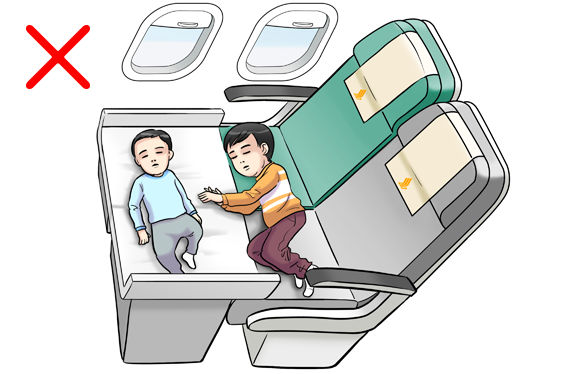
If you’ve purchased a separate passenger seat for your child, you may be able to bring your own inflatable flight cushion or convertible gadget to turn your child’s seat into a bed.

We do not allow the usage of seat extenders and foot hammocks onboard our flights for safety reasons.


BAGGAGE
We provide our young travellers with baggage allowance so that the family can have a fuss-free flight! Do refer to your e-ticket for the baggage allowance.
Depending on the itinerary and class of travel, infants will be entitled to check in up to 10kg* of baggage, or a piece of baggage up to 23kg/32kg*, along with a fully-collapsible stroller and car seat.
Alternatively, you can carry a compact, foldable lightweight stroller on board the cabin. If you’re departing from Singapore, you’ll also enjoy an additional 6kg of cabin baggage allowance for breast milk, infant food, and baby amenities. If you're departing from or transiting through other countries, contact Singapore Airlines for the country-specific restrictions.
If you have a Scoot flight in your itinerary, please note that all Scoot flights will require the stroller to be checked in at the aerobridge if there is no space in the cabin compartment. Checked baggage allowance for infants are included on Scoot-Singapore Airlines interline flights.
Checked baggage allowance for a child is the same as that for an adult, depending on ticket fare conditions.
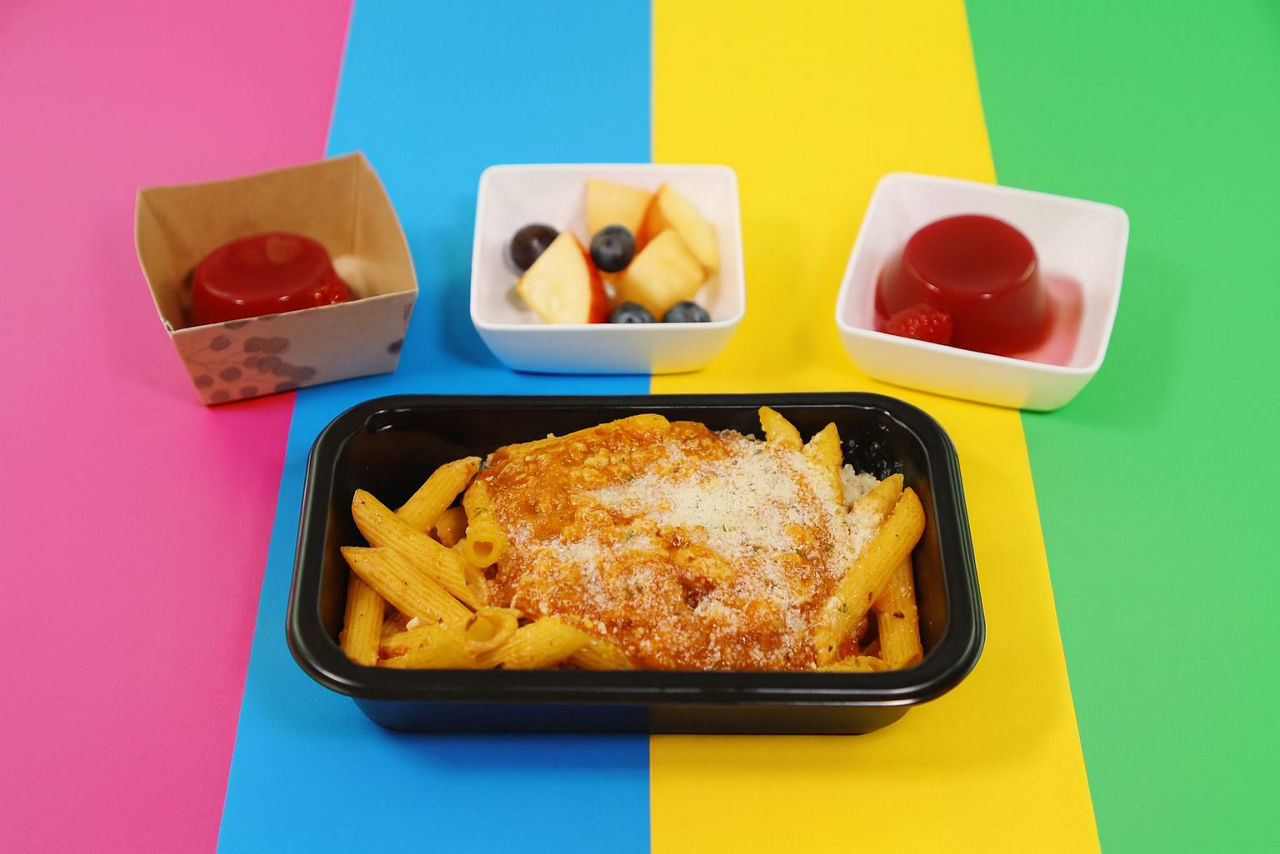
Flying for the first time? We have age-appropriate meals that are easy to chew and digest for your infant*. Travelling with older children? Let them choose between the Western, Asian, and vegetarian options**.
The little one is a fussy eater? No problem—you are more than welcome to bring your own food on board. We recommend bringing food that does not require chilling or heating due to operational restrictions.
Baby meal • Child meal for Infant
Western meal • Asian meal • Vegetarian meal
Child meal for infants and Asian/Vegetarian meal options for children may not be available on some flights. There is also no meal service in the Economy Class cabin on flights between Singapore and Kuala Lumpur due to the short flight time. Please refer to Manage Booking for the meal availability.
*Infants under two years old are only served Baby Meals or Child Meals for Infants on board. These Special Meals must be requested at least 32 hours before your flight via Manage Booking. Please note that we are unable to serve adult meals to infants under two years old.
**All child meals do not contain pork, pig by-products, ham or bacon.

AT THE AIRPORT
Children who are travelling in First or Business Class will be able to access our lounges according to the cabin class entitlement. Children aged 2 and above are considered as a guest under the 1 guest entitlement of KrisFlyer Gold members and above who are travelling in Premium Economy or Economy Class. Click here for more information on lounge access policy and guest entitlement.

Proceed to the boarding gate early! This will give you more time to clear security screening (in airports like Singapore’s Changi International Airport, where security screening is done at the gate), and ensure a smoother boarding experience for you and your young children.
You can carry a compact, foldable lightweight stroller on board the cabin if it meets the requirements. The stroller will be regarded as one piece of cabin baggage, and will count towards your cabin baggage allowance.
If your stroller does not meet the requirements or if there is no space in the cabin, it will be gate-tagged. Please retrieve your stroller at the aerobridge upon arrival.
Please note that gate-side retrieval of strollers at the aerobridge is not available for selected destinations.
ENTERTAINMENT

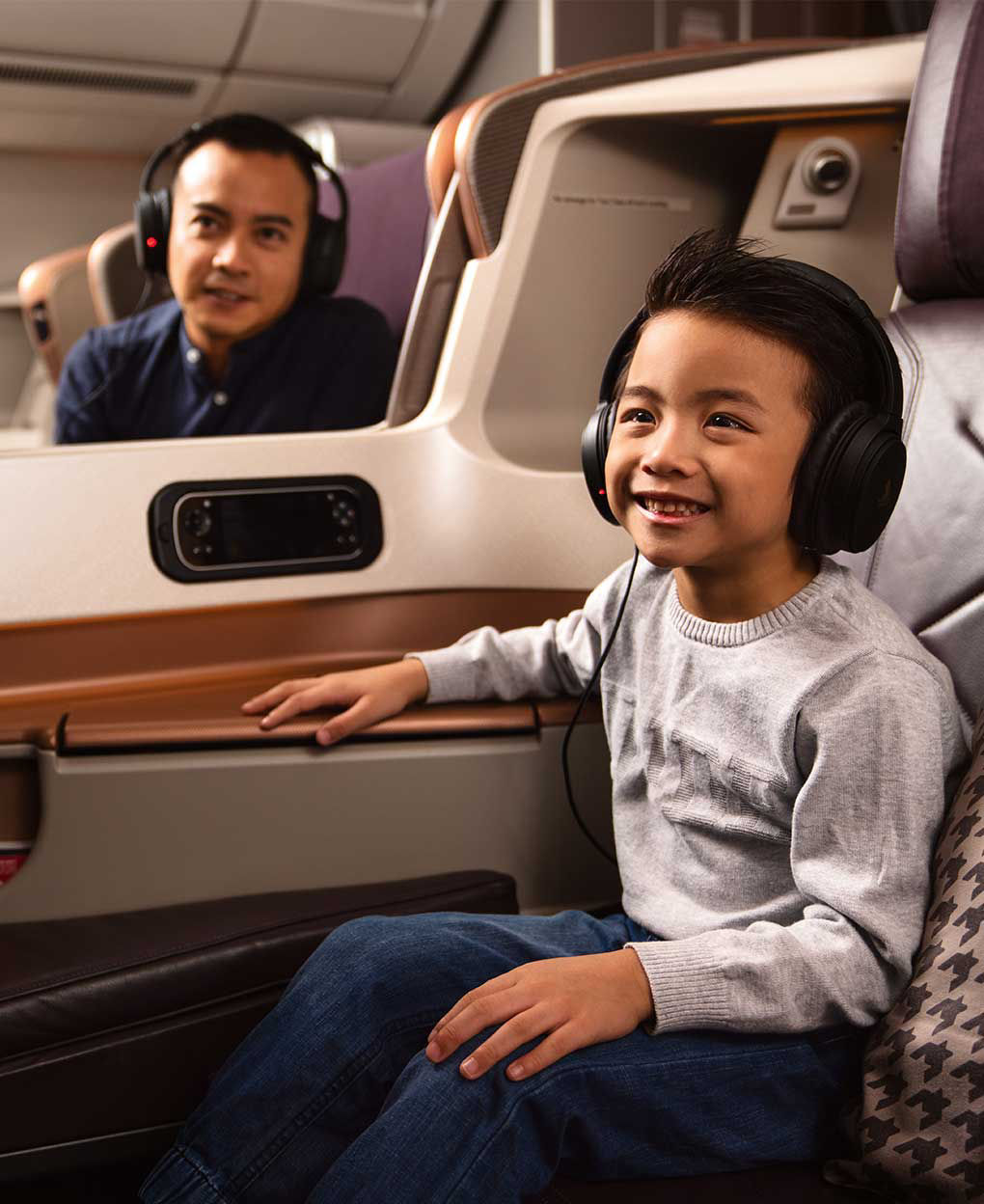
Flying with kids is a little less stressful when they are entertained. We know—that’s why we’ve created a Kids Mode feature. What’s more, kids can now enjoy playing games on their personal devices. Find out more here. It takes two simple steps to start.
(1) Connect to “KrisWorld network“ on your personal device.
(2) Enter https://kw.sq.com in your browser to start gaming!

Stuffed toy or activity pack with seasonal items. Subject to availability.
NURSING
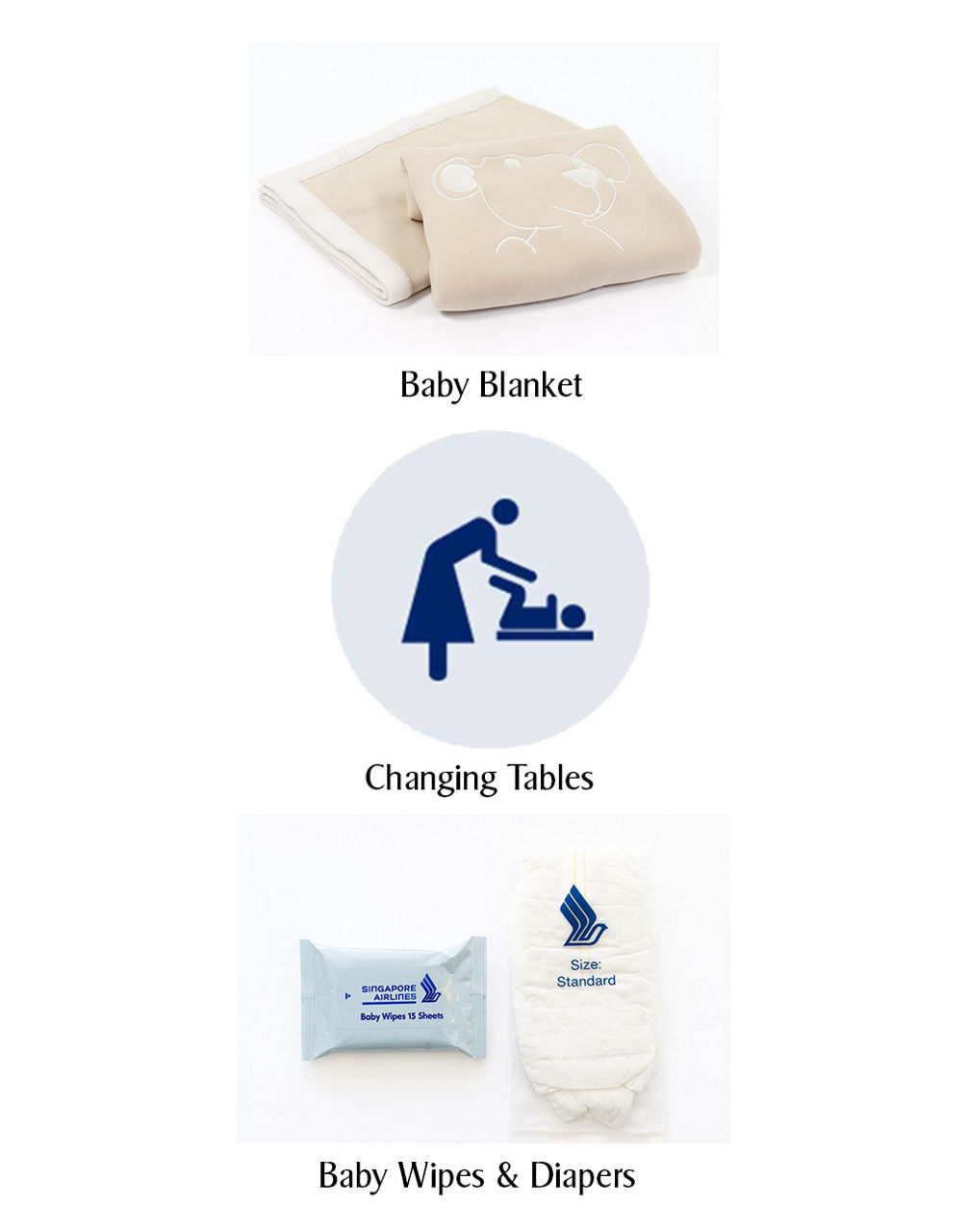
We believe it’s every mother’s right to be able to nurse their infant or express on board. You can choose to do so at your seat if you prefer—our crew will be happy to provide you with an extra blanket for added privacy.
*Both manual and electric breast pumps are allowed on board. However, do ensure that its batteries meet the approved guidelines.

You can bring as much breast milk as you need to nurse your infant during the flight. If you’re not travelling with your child, do store your milk in 100ml bags as the usual liquid restrictions will apply.
Baby wipes and baby diapers are available on board in limited quantities. However, we recommend that you bring your own as what we have may be different from what you are used to.
Changing table for your infant is available in certain lavatories on every aircraft.
Please check with the ground staff upon arrival for assistance on stroller retrieval.
Please note that retrieval at the aerobridge is not available for the following destination: Ahmedabad, Bandung, Chongqing, Copenhagen, Darwin, Dhaka, Kochi, Malé, Perth.
REGULATIONS
To protect the safety of children, certain countries require you to prepare additional documents when you are travelling with a child.
French residents—regardless of nationality—under 18 years old who are flying from France without his or her parents or legal guardians will need to provide the following documents:
Nationals of Italy below 14 years old, who are unaccompanied or accompanied by someone other than the parent/guardian stated on page five of the minor’s passport, are required to have an authorisation form (Dichiarazione di Accompagnamento) signed by both parents and issued by the local police, when traveling to or from Italy.
If the passenger’s parents reside abroad, the authorisation form must be issued by an Italian embassy or consulate.
If the passenger is traveling from Italy, his or her parents/guardians may submit the travel authorisation request online through here.
All passengers under the age of 18 who are travelling into or out of South Africa must provide additional documents.
Please refer to the South African Department of Home Affairs website for details.
Thai nationals under the age of 18 who are travelling from Thailand unaccompanied or with only one parent or guardian must provide additional documentation, such as a birth certificate and government issued letter of consent from the non-travelling parent(s).
For more information on the required documents and procedures, please contact the local district offices in Thailand.
All passengers under the age of 18 who are travelling into or out of the Philippines must provide additional documents.
Please refer to the Department of Social and Welfare Development website for more details.
Nationals of Vietnam below 14 years old must be accompanied by their parents or legal guardian, when travelling from Vietnam. If the accompanying person is not the minor’s parent or legal guardian, they are required to produce a letter of authorisation signed by the parents or legal guardian. Please download the letter from the link below.
Letter of Authorisation
You can carry a compact, foldable lightweight stroller on board the cabin if it meets the requirements below. The stroller will be regarded as one piece of cabin baggage, and will count towards your cabin baggage allowance.
Singapore Airlines reserves the right to reject strollers that are not appropriately packed. If your stroller does not meet the requirements or if there is no space in the cabin, it will be gate-tagged. Please check with the ground staff on the stroller retrieval location upon arrival.
Please note that retrieval at the aerobridge is not available for selected destinations.
If you have checked in your stroller at the counter, it will be available for pickup at the baggage belt.
If you are a passenger with connecting flights:
Please check with the ground staff after disembarkation if you require any assistance.
Please note that retrieval at the aerobridge is not available for selected destinations.
If you’ve purchased a separate passenger seat for your child, you’re welcome to bring your own inflatable flight cushion or convertible gadget to turn your child’s seat into a bed.
Just be sure to pick a window seat or the middle seat in the centre section—and follow the manufacturer’s instructions for use.

You must also meet the following requirements:
Approved child harnesses or child car seats may be used for children under three years old who occupy their own seat.
However, they cannot be used in the emergency exit rows, and the rows immediately before and after them.
Child harnesses must be approved by the Federal Aviation Administration (FAA) which includes the AmSafe Child Aviation Restraint System (CARES) child harness.
CARES child harnesses may not fit in some of our First Class and Business Class seats. For details, contact Singapore Airlines.
A child car seat can be brought on board the plane if it meets the following criteria:
Regulatory requirements
Child car seats must be approved by a foreign airworthiness authority and meet government standards, such as:
Show our ground staff and cabin crew where the approval labels are located on your child car seat when asked.
Physical requirements
Child car seats must meet these physical attributes: